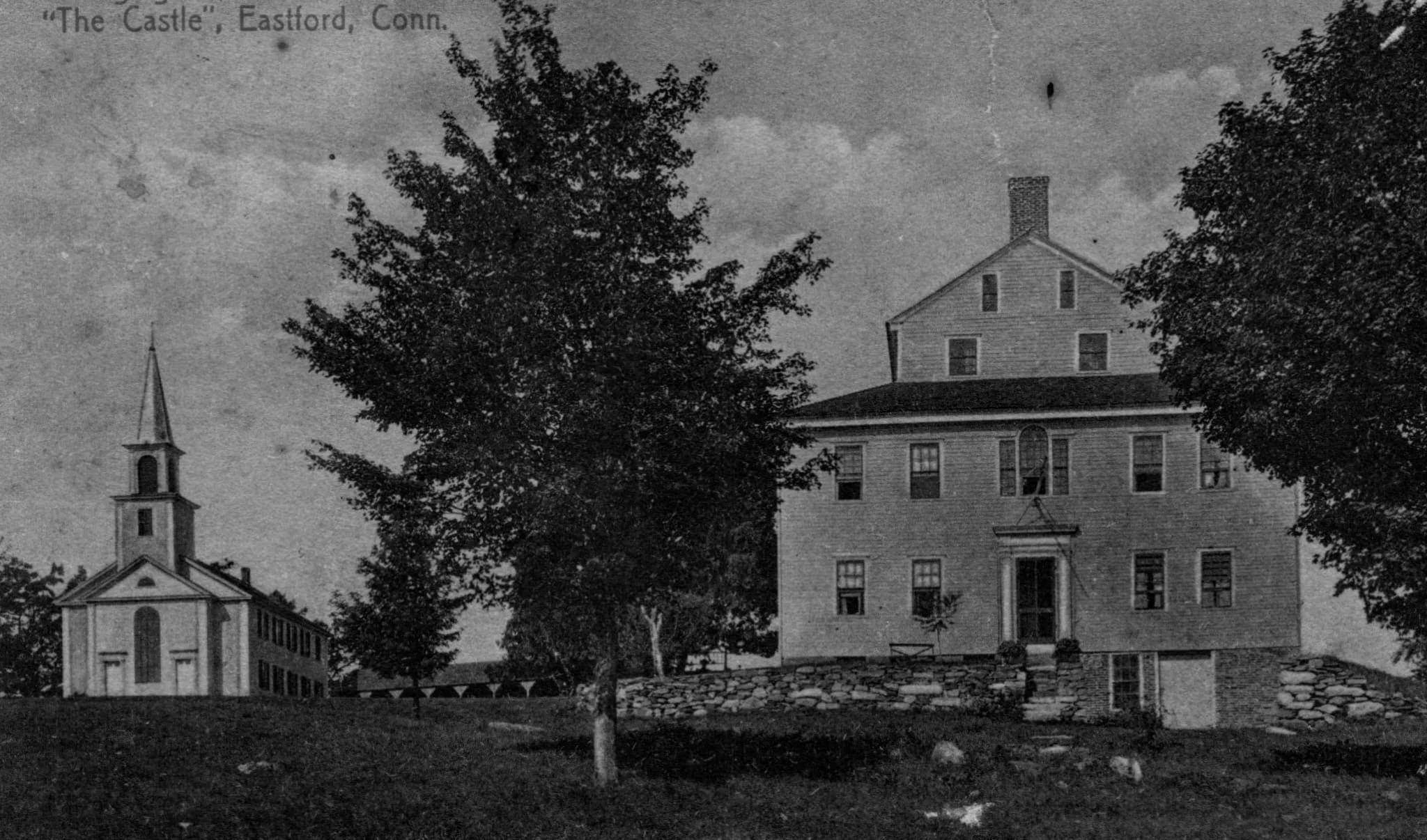
The Castle
Circa 1791 Mansion House and Masonic Lodge
The property known today as The Castle began its history when Squire Benjamin Bosworth acquired the site in 1791, at which time an earlier dwelling already stood on the property. Bosworth most likely incorporated portions of that earlier structure into the present house, undertaking a comprehensive rebuilding and expansion from the time of his purchase through the close of the 18th century. By 1799–1800, the residence had taken on the substantial and refined form recognizable today.
This evolving homestead soon became more than a private residence. In the winter of 1800, the house hosted the first Masons meeting in the area, establishing its enduring association with local fraternal history and giving rise to its identity as both a Mansion House and Masonic Lodge.
Architecturally, the home is remarkable for featuring the earliest monitor roof in Connecticut, an innovative element that distinguishes it among structures of its era. Inside, fine craftsmanship is on full display. The Parlor contains some of the region’s most impressive period woodwork, carved over the course of an entire winter by Vinni Goodell, a local housewright and carpenter whose elaborate detailing remains a signature feature of the home.
For much of the 1830s through the 1860s, another room—now known as the “Boardroom”—served the town in a civic capacity as the local Post Office for more than 30 years, cementing the property’s role at the heart of community life.
Untouched 18th century
This remarkably intact eighteenth-century dwelling exhibits a high degree of architectural and material preservation across its principal spaces. The formal front entry, opening into an early ballroom, represents a rare survival of a socially significant interior plan seldom encountered in domestic structures of the period. The parlor contains exemplary Eastern Connecticut punch-and-gouge woodwork, offering an important regional expression of vernacular craftsmanship. Equally notable is the presence of an original Masonic Lodge room, its historic benches remaining in situ and providing valuable evidence of early fraternal use within a domestic context. The cellar and storeroom retain their original configuration and fabric, contributing to a fuller understanding of eighteenth-century household economy and spatial organization. Throughout the structure, the inclusion of very early Rumford-style fireplaces further enhances its architectural significance, illustrating the adoption of emerging heating technologies during the period. Collectively, these features position the property as a rare and exceptionally well-preserved example of early New England domestic architecture.
Circa 1800 Masonic Meeting Room at “The Castle”